Christmas Lighting
Christmas Light Design Ideas for Cincinnati Homes
New Age Lights • September 2026 • Cincinnati, OH • 8 min read
Start with the house, not the catalog
Cincinnati has some of the most varied housing of any metro we work in. A design that looks deliberate on a nineteenth-century Italianate in Covington looks lost on a three-story executive home in Mason. The Festival of Lights at the Cincinnati Zoo has been a metro habit for generations, so people here know what a well-built display looks like. The way to meet that bar on your own house is to let the roofline, the trim and the sightline decide. At a New Age Lights consult that is exactly what happens: we walk the property, show you where the run will sit, and cut it to the house on site, as described on the Christmas light installation page.
The building blocks
Roofline outlining
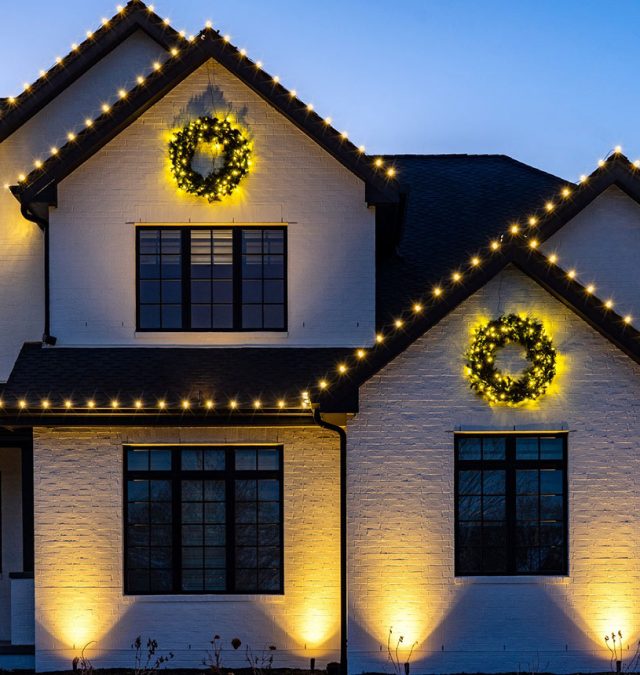
The gutter line across the front elevation is the foundation of almost every display. A continuous run of C9 bulbs at even spacing, turning cleanly at every corner, is what makes a house read as lit from the street.
Ridge lines and gables
Following the gable up to the peak and back down turns an outline into a silhouette. On the steep pitches in Hyde Park and Norwood this is where the drama is. Ridge lines add a second layer on wide, low-pitched houses but are often unnecessary on tall ones.
Columns, porches, wreaths and garland
Wrapped porch columns bring the light down to eye level, which matters on the deep wrapped porches common in Wyoming, Norwood and Fort Thomas. A lit wreath above the garage or the entry gives the eye a focal point, and garland over the door softens a hard roofline. On a historic front, one well-placed wreath on the cornice does more than a dozen small ones.
Tree wraps and shrubs
Wrapping trunks and major limbs in mini lights is what makes a display feel full rather than outlined. Mature hardwoods in Fort Thomas and Mount Lookout are slow work at height, and the most striking thing on the street when done properly. Lit shrubs fill in the ground plane.
C9 vs mini lights
| C9 bulbs | Mini lights | |
|---|---|---|
| Best use | Roofline, gables, ridge lines, garage and porch edges | Tree trunks, shrubs, columns, garland, wreaths |
| Look | Large, distinct points of light, traditional, reads from a distance and from below | Dense, soft glow, fills volume |
| Professional product | Commercial-grade LED bulbs seated into a custom-cut run | Commercial-grade strands wrapped to a spacing plan |
| Where it struggles | Wrapping anything; too bulky | Roofline outlines look thin and uneven from the street |
| Cincinnati note | Reads well across a hillside and from a set-back lot | Mature-tree wraps are the labor-heavy add-on here |
Almost every professional design here uses both: C9 for the architecture, minis for the greenery. Choosing one for everything is the most common DIY mistake, and why homemade displays look thin on the roof or bulky in the trees.
Warm white, cool white or multicolor
This is the choice people agonize over, and there are a few reliable rules.
- Warm white against brick and stone. Red and brown brick, limestone sills and slate all want a warm tone. Cool white reads blue-ish against masonry and can look clinical on a nineteenth-century front.
- Cool white against gray, white and modern. Painted siding, gray brick, white trim and contemporary elevations carry cool white well, and it pairs with blue for a winter look. Much of the newer stock in Mason, West Chester and Independence can go either way.
- Multicolor for festive, and for children. Traditional red, green, blue and gold on the roofline is unapologetically Christmas and works best on modern fronts where the architecture is not competing. The classic compromise is warm white on the roofline and color on the trees, which lets the house look finished and the yard look fun.
- Historic districts and HOAs lean warm white. Over-the-Rhine, the Covington and Newport historic blocks, and most HOA neighborhoods on both sides of the river will be happier with a single warm tone. More on that below.
The color-changing option
Seasonal RGB runs with a simple remote let a temporary display shift between a handful of colors, which is how some Cincinnati homes go orange and black for a Bengals Sunday and back to warm white on Monday. The limits are those of a remote: few colors, no scheduling, no zones.
If everyday color control is the point, that is the case for a permanent track. A JellyFish or Bosso system fitted under the eave runs warm white as everyday trim, color through December, red for an Opening Day weekend, orange and blue for an FC Cincinnati match, red and black for the Bearcats, or Kentucky blue south of the river, all from your phone with saved scenes and schedules. The channel is color-matched to the trim, so it is discreet in daylight, and nobody touches the roof between November and March. Our JellyFish page covers where it fits around Cincinnati.
Design by neighborhood and house style
Nineteenth-century brick and slate: Hyde Park, Clifton, Mount Adams, Norwood, Wyoming
Steep pitches, deep cornices, slate, and gutter replaced piecemeal over a hundred years. The design here is restraint and line. Warm white C9 along the cornice and up the gables, fixed to the fascia line rather than clipped to slate, with the spacing held even across the whole elevation. One wreath on the cornice or above the entry. Wrapped columns if there is a porch. Skip the ridge line; the pitch does the work. These houses look best when the lighting reads as the architecture drawn in light.
Hillside houses: Mount Adams, Mount Lookout, Price Hill
Design for the view from below. These houses are seen from the street or the hillside beneath them, so the roofline outline does most of the visual work. Keep the run clean and continuous on the elevation people actually see, light the trees that frame the view, and do not spend money on elements nobody will be positioned to look at.
Historic river blocks: Over-the-Rhine, Covington, Newport
Italianate fronts, cornices, stone sills, party walls, and historic-district rules where the daytime appearance of a fixture matters as much as the lit result. A single warm tone along the cornice and around the entry, wreaths in the upper windows, and nothing that reads as equipment in daylight. On a Covington or Newport terrace the frontage is narrow and the design should be too. See our Newport and Covington pages for what those installs involve.
Early-twentieth-century bluff houses: Fort Thomas
Substantial brick and stone, steep pitches, slate and tile, deep eaves, mature hardwoods over the street. This is where tree wraps earn their keep. Warm white on the roofline and gables, then two or three mature trunks wrapped in minis to frame the house under the canopy. Under tree cover the ground-level elements matter more than the ridge.
Modern executive housing: Mason, West Chester, Indian Hill edges
Large frontages, long straight fascia, seamless gutter, two- and three-story elevations. The house can carry a bolder design: full roofline and gable outline, wrapped entry columns, a large wreath above the garage, lit trees along the driveway. Warm or cool white both work depending on the facade, and this is the housing where a multicolor roofline looks intentional rather than busy. Our Mason page covers the height and footage involved.
Suburban two-stories: Fairfield, Florence, Independence
Straight fascia, brick and vinyl, gables over the entry, often set well back on rolling ground. The gable outline is the signature element, and on a set-back lot a clean C9 roofline with a wreath and a couple of lit trees reads better at distance than anything more elaborate. Color on the trees looks right here.
HOA-friendly restraint
Many newer subdivisions in Mason, West Chester, Florence and Independence have covenants on holiday lighting: turn-on and turn-off dates, hours, sometimes color or brightness. The design that keeps everyone happy is a single-color roofline outline, usually warm white, wreaths at the entry and garage, and lit trees in the same tone. Bring the covenants to the consult and the plan gets built inside them, which is cheaper than redoing a run after a board letter. For a permanent system, the HOA rules for permanent lighting in Cincinnati post covers approvals.
Commercial storefront design
A storefront is designed to be compared with the unit next to it. Along Kenwood, Rookwood, Deerfield Towne Center, Mall Road in Florence, MainStrasse Village and Newport on the Levee, a dark facade beside a lit one loses. The principles are a house scaled up: a continuous roofline or parapet outline, entries and signage framed, and a single tone that reads as the brand. Downtown and Over-the-Rhine frontage on historic brick and cast iron wants lighting that reads as architecture, not decoration. Our commercial Christmas lighting in Cincinnati post goes deeper.
Frequently asked questions
Should I choose warm white or multicolor Christmas lights?
Warm white suits the brick, stone and slate housing that dominates Hyde Park, Clifton, Wyoming, Fort Thomas and the Kentucky river towns, and it is the safer choice in historic districts and HOA neighborhoods. Multicolor reads as festive and works well on modern fronts in Mason, Fairfield and Florence, especially with children in the house. Many Cincinnati homes use warm white on the roofline and color on the trees.
What is the difference between C9 and mini lights?
C9 bulbs are the large, traditional roofline bulb, spaced along a custom-cut run, and they read clearly from the street or from below a hillside. Mini lights are small, dense and best for wrapping tree trunks, shrubs, columns and garland. Most professional designs use C9 on the roofline and minis on the greenery, not one or the other everywhere.
Warm white or cool white for a brick house?
Warm white, almost every time. Cool white reads blue-ish against red and brown brick and can look clinical on nineteenth-century masonry. Cool white suits gray, white and modern facades, and it pairs well with blue for a winter look. If you want a crisp white without the blue cast, a color-changing system with a dedicated true-white diode can dial it in.
How should I light a house on a hillside in Cincinnati?
Design for the view from below. Houses in Mount Adams, Mount Lookout and Price Hill are seen from the street or the hillside beneath them, so the roofline outline does most of the work and details near ground level matter less. Keep the run clean and continuous, light the elevation people actually see, and skip elements that will never be in the sightline.
Can Christmas lights change color for game day?
Seasonal RGB runs with a remote can shift between a handful of colors, so orange and black for a Bengals Sunday or red for the Reds is possible on a temporary display. For everyday color control with saved scenes, zones and schedules, a permanent JellyFish or Bosso track does it from your phone all year.
See the design on your own house
The consult is free. We walk the roofline, show you where the run sits and how it reads from the street, and give you a fixed number before anything is ordered.
Get a free quote or call (513) 713-0490.