Christmas Lighting
DIY vs Professional Christmas Lights in Cincinnati: Safety, Cost and What Usually Goes Wrong
New Age Lights • September 2026 • Cincinnati, OH • 8 min read
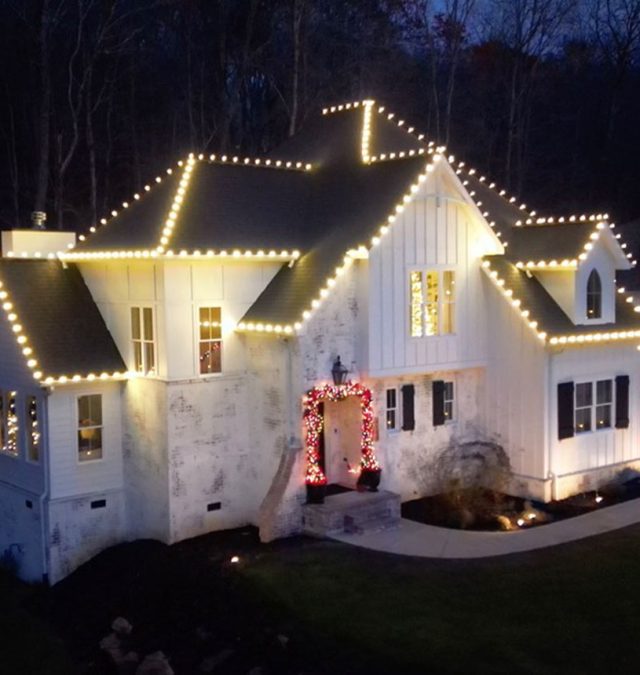
The question is not "can you," it is "should you, on this house"
Plenty of people in Cincinnati hang their own lights well. The honest way to frame the decision is by house and by weather, not by pride. A brick ranch in Fairfield with a walkable roofline, a driveway to stand in and a dry Saturday in early November is a reasonable DIY job. A three-story rear elevation over a walkout in Mason, a slate roof with a deep cornice in Wyoming, or a Mount Adams house on a hillside behind a retaining wall is not. Three things decide it: the safety of being up there, what fails in an Ohio Valley winter, and what DIY really costs.
Safety: height, pitch, slate and December
Ladder falls send thousands of people to emergency rooms every holiday season, usually a homeowner on an extension ladder, reaching sideways, on uneven ground or a wet surface. Cincinnati adds every aggravating factor at once.
- Height. A two-story front is a long way up. Mason, West Chester, Florence and Independence are full of tall modern elevations, and rolling lots often put the rear roofline a full story higher than the front suggests.
- Pitch. Hyde Park, Clifton, Mount Adams, Norwood and Wyoming carry steep nineteenth and early-twentieth-century pitches. These are not roofs to walk.
- Slate. The same neighborhoods have slate, which is slick when wet or frosted, unforgiving underfoot, and cracks under a misplaced boot. A cracked slate is a roofing bill, and a slipped boot is worse.
- Hillsides. Mount Adams, Mount Lookout and the Price Hill side put houses on steep ground with retaining walls and nowhere level to set a ladder foot. Professional crews plan lift access before they arrive. A homeowner improvises.
- The weather itself. December here averages a high near 42°F and a low near 27°F. The days you would be up there are cold, often wet, sometimes icy, and the sun is down by about 5:30. Hands get numb, footing gets worse, and the job takes longer than planned.
Our crews work at height with the right access equipment as a matter of routine, and on slate they never set foot on the tile; the work is done from the fascia line. That is a different proposition from a homeowner on an extension ladder against a gutter on a Sunday afternoon in late November.
What usually goes wrong: freeze-thaw and clip failure
In our southern markets a DIY display fails from wet. In Cincinnati it fails from cold, specifically the daily freeze-thaw cycle. An afternoon above freezing lets water into a socket, under a clip or into an unsealed plug. Overnight it freezes and expands. Repeat that for a month and here is what happens.
| Failure | What causes it here | How a professional install avoids it |
|---|---|---|
| Plastic clips snap | Retail clips get brittle in sustained cold, then ice weight on the run breaks them | Edge-matched commercial clips, spaced closer for snow load |
| Run sags or slides off the gutter | Gutter clips lose grip under ice load; piecemeal old gutter has no uniform lip to hold | Fascia-line fixing on old edges, clip spacing set for load |
| Half a string goes dark | Water in retail sockets freezes and opens the circuit; corroded plug connections | Commercial-grade C9 sockets, sealed connections, sections that can be isolated |
| Timer or cord failure | Indoor-rated cords and timers outdoors; connections lying in slush | Outdoor-rated power path planned at the consult, connections off the ground |
| Nothing gets fixed | The fault is on a frozen roof and nobody wants to go up | In-season service visit; the crew has the equipment to work safely |
The most common outcome is a display that looked fine on December 1 with a dark stretch over the garage by December 15 and a sagging corner by Christmas, and a homeowner who quite sensibly decides not to go up on an icy roof to fix it. A professional program exists for that scenario: if a section goes dark, you call and the crew comes back.
The real cost of DIY
The actual list for a two-story front is longer than a box of lights. These are rough big-box retail bands, not quotes, and they move year to year, so check current prices.
| Item | What a two-story front typically needs | Rough retail band |
|---|---|---|
| Light strings | Enough C9 or mini strings to cover 100–200 ft of roofline, plus spares | Low hundreds of dollars for LED sets |
| Clips | One every foot or two along the gutter, plus shingle or fascia clips at gables | Tens of dollars |
| Outdoor timer | At least one, outdoor-rated | Tens of dollars |
| Extension cords | Two or three outdoor-rated cords to reach the outlet without crossing a walkway | Tens of dollars each |
| Ladder | An extension ladder tall enough for a two-story eave, if you do not own one | A significant one-off purchase |
| Your time | A weekend to hang and test, a day to take down, plus any December repair trips | Not free |
| Replacement | Retail strings often need replacing after a couple of Ohio winters | Recurring |
Add it up and a first-year DIY display for a typical two-story front comes to a few hundred dollars in product before your weekend, and before the strings that die in year two. Against that, a professional roofline-only program typically runs $700 to $1,500 in year one, less on renewal, and it includes commercial-grade product, install, service, takedown and storage. The numbers are closer than most people expect, and the gap is mostly your time, your risk and who owns the repair. Our Cincinnati cost guide has the full breakdown.
When DIY genuinely makes sense
We would rather tell you this straight than sell you an install you do not need. DIY is a reasonable choice when most of these are true:
- Your house is single-story, or the roofline you want lit is reachable from a step ladder or a low, walkable roof.
- You have a helper to foot the ladder and hand things up, and you can pick a dry, mild day in October or early November.
- The design is a modest roofline outline, not tree wraps at height or a second elevation.
- You are buying decent LED product and outdoor-rated cords.
- You are willing to own the repair, or live with a dark section, if something fails on a frozen roof in December.
A lot of Norwood, Fairfield and older Florence housing fits that description, particularly the ranches and low two-stories. If that is you, do it, do it in daylight, and never stand on slate.
When to hire it out
Hire a professional when the house or the site makes the ladder the problem.
- Two-story fronts and steep pitches anywhere, and especially the tall modern elevations in Mason, West Chester and Independence.
- Slate, tile and deep cornices in Hyde Park, Clifton, Norwood, Wyoming and Fort Thomas, where the run has to be designed around the detail and fixed to the fascia line.
- Hillside lots in Mount Adams, Mount Lookout and Price Hill, where access is the whole job.
- Historic and party-wall streets in Over-the-Rhine, Covington and Newport, where the frontage is reached from the sidewalk and daytime appearance matters.
- Anything you would need to climb in December. If the display is going to need a service visit, you want it to be someone else's.
The Christmas light installation page lists what a New Age Lights program includes, and twelve questions to ask a Cincinnati installer will help you compare quotes if you decide to hire.
The third option: never climb again
There is a version of this decision that removes the ladder permanently. A roofline track from JellyFish Lighting or Bosso is fitted once under the eave, color-matched to the trim so it reads as part of the house in daylight, and controlled from an app. Warm white on an ordinary evening, color through December, red for an Opening Day weekend, off the rest of the time. In a climate where nobody wants to touch the roof between November and March, that is the main reason people here choose it over seasonal.
It is not right for every house. On the older hillside stock and the historic river blocks there is often not enough uniform fascia to seat a channel out of sight, and a seasonal display is the better call. On the straight-fascia housing in Mason, Fairfield, Florence and Independence it fits without argument. Our JellyFish page explains where it works, and the permanent vs seasonal comparison for Cincinnati does the five-year math.
Frequently asked questions
Is it safe to put Christmas lights on my roof myself?
On a single-story house with a walkable pitch, dry conditions and a helper footing the ladder, it can be. On a two-story front, a steep pitch, slate, or a hillside lot, it is not a reasonable weekend job. Ladder falls send thousands of people to emergency rooms every holiday season, and in Cincinnati the days you would be up there are cold, often wet and sometimes icy.
How much does it cost to do your own Christmas lights?
For a two-story front you are typically buying several C9 or mini light strings, clips for every foot or two of gutter, at least one outdoor timer and two or three outdoor-rated extension cords, plus the ladder if you do not own one. Using rough big-box retail prices that adds up to a few hundred dollars in year one before your weekend, and retail strings often need replacing after a couple of Ohio winters.
Why do Christmas light clips fail in Cincinnati?
Freeze-thaw cycles. Water gets under a clip or into a socket during a 42°F afternoon, freezes overnight at 27°F, expands, and repeats for weeks. Plastic retail clips get brittle in the cold and snap, gutter clips slide when ice weighs the run down, and unsealed connections corrode. Commercial installs use closer clip spacing, edge-matched hardware and sealed joins for exactly this reason.
What do professional installers do differently from DIY?
They use commercial-grade C9 LEDs on runs cut to your roofline, clips matched to shingle, gutter or fascia with nothing driven through roofing, sealed connections, closer spacing for snow load, proper access equipment for height, and they come back if a section fails. In Cincinnati they also work slate from the fascia line and plan hillside access before the day.
When does DIY make sense for Christmas lights?
When your house is single-story or has a low, walkable roofline, you have a helper, you can pick a dry mild day, you are outlining a modest run rather than wrapping trees at height, and you are comfortable owning the repair if a string dies in December. Many Norwood and Fairfield ranches fit that description. A three-story Mason rear elevation or a Clifton slate cornice does not.
Not sure which side of the line your house is on?
Book a free consult. We will walk the roofline, tell you honestly whether it is a DIY job, and give you a fixed number if it is not.
Get a free quote or call (513) 713-0490.