Permanent Lighting
Permanent vs Seasonal Christmas Lights in Cincinnati: The Honest 5-Year Comparison
New Age Lights • August 2026 • Cincinnati, OH • 8 min read
What you are actually comparing
A seasonal program is a service. A crew designs a display around your roofline, installs commercial-grade C9 LED on custom-cut runs, services it if a section goes dark, takes it down in January and stores it until next year. You pay every year, and in a lease model you do not own the lights. Our Christmas light installation page describes what is included.
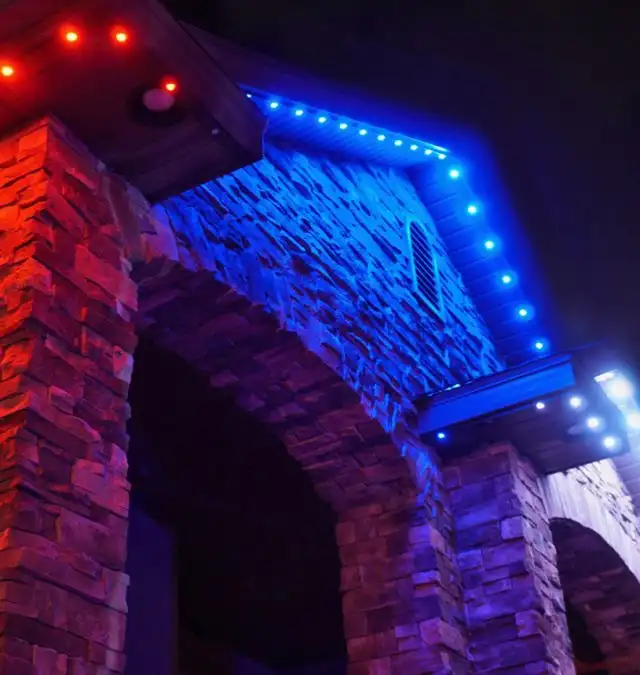
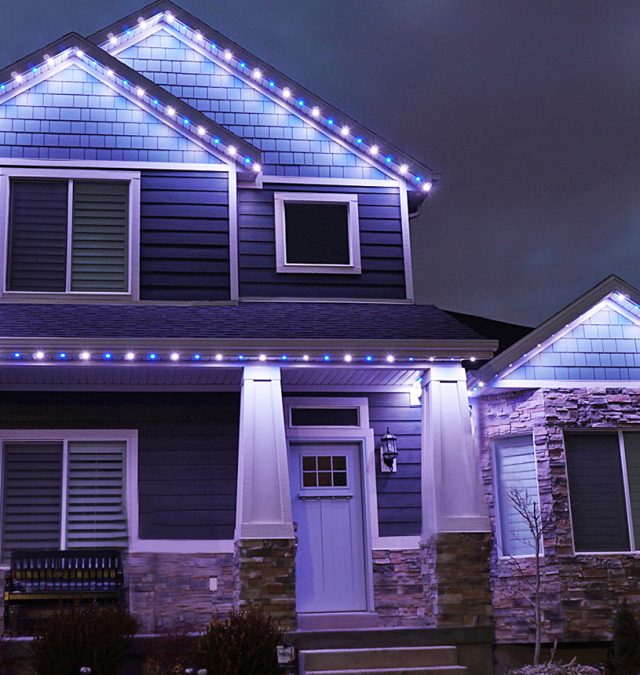
A permanent system is a fixture. A slim, color-matched aluminum track goes under your eave once, with individually addressable LED lights inside, a controller in the garage, and an app. You own it, it stays up, and it runs whatever color you want on whatever schedule you set. In Cincinnati we install two of these, JellyFish Lighting and Bosso Smart Lighting, and the residential lighting page covers both.
The five-year cost model
Every figure below is labeled. The seasonal numbers are typical industry ranges for turnkey programs, not New Age Lights prices; ours are fixed after a free site visit. The permanent numbers are the manufacturers' published averages.
Assumptions. Seasonal roofline-only: $1,200 a year, the midpoint of the typical $700 to $1,500 range. Seasonal mid-range display with trees and wreaths: $2,500 a year, the low end of the typical $2,000 to $5,000-plus range. Renewal years on a lease are normally lower than year one; this model holds them flat, which favors seasonal slightly. Permanent: $4,600 once, the JellyFish national average, or about $5,000 for Bosso's stated average customer. Electricity is excluded on both sides; a JellyFish puck at full-bright white draws under 1 W, and Bosso says a 250-light system draws about what five ordinary bulbs draw.
| Cumulative spend | Seasonal, roofline only | Seasonal, mid-range display | Permanent, JellyFish average | Permanent, Bosso average |
|---|---|---|---|---|
| Year 1 | $1,200 | $2,500 | $4,600 | $5,000 |
| Year 2 | $2,400 | $5,000 | $4,600 | $5,000 |
| Year 3 | $3,600 | $7,500 | $4,600 | $5,000 |
| Year 4 | $4,800 | $10,000 | $4,600 | $5,000 |
| Year 5 | $6,000 | $12,500 | $4,600 | $5,000 |
| Break-even vs permanent | Year 4 to 5 | Year 2 |
Two things the table leaves out cut in opposite directions. A large Mason or West Chester home with 250 feet of roofline sits well above the average, at roughly $6,250 to $8,750 by the published per-foot range, which pushes break-even later. On the other hand, both permanent systems carry a five-year parts warranty and are rated around 50,000 hours, so the honest comparison horizon is closer to fifteen years than five, and by then the seasonal column has tripled. For worked examples by neighborhood, see what permanent outdoor lighting costs in Cincinnati; for the seasonal side, what Christmas light installation costs in Cincinnati.
Are permanent Christmas lights worth the cost?
If you already pay a professional every year, yes, within two to four seasons depending on how big your display is. If you hang lights yourself, the spreadsheet is less kind: your seasonal cost is a few hundred dollars of retail strings and clips plus your weekends, and permanent lighting will not pay that back in cash. In that case the question is what the weekends and the ladder are worth, and in this climate that is a real number even if it is not a dollar figure.
Where permanent lighting is genuinely not worth it: a house you will leave in two years, a roofline that will not seat a track discreetly, or a homeowner whose idea of Christmas lights is the trees and the wreaths rather than the outline.
What the money does not capture
No ladders in a Cincinnati winter
This is the one people mention first. December here averages a high near 42°F and a low near 27°F, snow sits on a roofline instead of passing through, and a freeze can hold for days. With a seasonal display, that is the weather the lights go up in and the weather a January fault gets fixed in. With a permanent track, nobody touches the roof between November and March, and if a zone misbehaves you open the app or call us. On a two-story Florence rear elevation over a walkout, or a Mount Lookout house on a hillside behind a retaining wall, not going up there is the whole point.
Warm white on the other 330 evenings
Seasonal lights are up for perhaps five or six weeks. A permanent track runs warm white as architectural trim every other evening of the year, on a sunset schedule, and it doubles as security lighting around the whole roofline. Most of our Cincinnati customers tell us the everyday white ends up being the setting they use most, and Bosso's dedicated true-white diode is one reason some of them choose it.
Game days and the rest of the calendar
Orange and black on a Bengals Sunday, red for Opening Day, orange and blue for FC Cincinnati, Kentucky blue on the Northern Kentucky side, orange for Halloween, red, white and blue in July. All of that is a preset, and none of it is possible with a seasonal display that comes down in January. Details in game day lighting in Cincinnati.
A fixture, not a box in the garage
A permanent system stays with the house, with a warranty that can be registered to a new owner. Whether it moves the sale price is not something we have data on, so we will not claim it. What it does is remove a recurring cost and a recurring chore from the next owner's list.
What permanent lighting cannot do
- Trees, shrubs, wreaths and garland. A track lights the roofline. It does not wrap a maple in the front yard, hang a wreath on every window or run garland down the porch rail. If that is the display you love, seasonal is the product, or a permanent roofline plus a small seasonal package for the greenery.
- Vanish on every house. On straight modern fascia in Mason, West Chester, Fairfield, Florence or Independence, a color-matched track reads as trim. On a slate-roofed Hyde Park or Clifton house with a deep cornice and gutter replaced piecemeal over a century, there may be no uniform edge to seat it discreetly, and in the historic districts of Over-the-Rhine, Covington and Newport a fixture visible in daylight is simply the wrong answer.
- Work without Wi-Fi. Both apps need a solid connection to the controller. On a large lot with the controller in a detached garage, that is a detail to sort out at the consult.
- Move with you. It is fixed to the house. If you are two years from selling, a seasonal program is the better fit.
Who should still choose seasonal lights
- You want a full display, trees and wreaths included, not a roofline outline.
- You live in a historic district or an older brick house where a permanent fixture would show in daylight.
- You rent, or plan to move within two or three years.
- Your roofline is short and reachable, as on many Norwood lots, so the seasonal cost is at the low end and break-even is far off.
- You want to try professional lighting for a season before committing to a fixture. Plenty of our permanent customers in Fairfield and Florence started this way.
None of those are consolation prizes; a designed, serviced seasonal display is a good product. Our post on takedown, storage and maintenance covers the part of the seasonal service people underestimate.
How long do permanent outdoor lights last?
Both systems we install are rated around 50,000 hours. JellyFish translates that as roughly 15 to 20 years of evening use and points to installs from 2016 still running; Bosso says 25 to 30 years at about five hours a night. The two figures are the same rating read at different nightly hours. Both carry five-year parts warranties with year one covering labor, and because New Age Lights installs and services every system we sell, a dropped run is a call to us, not to a manufacturer's support line.
The Cincinnati climate, on both sides of the ledger
The Ohio Valley winter makes the case for permanent lighting more strongly than anywhere else we work, and it raises the bar for how a track is installed. Fixing spacing here is set for snow load and sustained freeze, not for a mild winter, every penetration is sealed, and the track is fastened to the fascia or drip edge, never through roofing. A system installed to a southern specification would not be the bargain it looked like. For the detail, read will permanent lighting damage my roof, soffit or fascia.
Frequently asked questions
Are permanent Christmas lights worth the cost?
If you would otherwise pay for a professional seasonal display every year, a permanent system at the JellyFish national average of about $4,600 breaks even against a mid-range display in about two seasons and against a small roofline-only display in about four. If you would otherwise hang lights yourself, the case rests on never being on a ladder in a Cincinnati winter and on using the lights year-round.
What is the average cost of permanent Christmas lights?
JellyFish Lighting publishes $25 to $35 per linear foot installed, typical homes $3,000 to $6,000, and an average around $4,600. Bosso Smart Lighting says its average customer spends about $5,000. Typical seasonal programs, by comparison, run about $700 to $1,500 a year for a roofline-only front and $2,000 to $5,000 or more for a full display.
How long do permanent outdoor lights last?
Both systems New Age Lights installs are rated around 50,000 hours. JellyFish translates that as roughly 15 to 20 years of evening use; Bosso says 25 to 30 years at about five hours a night. Both carry five-year parts warranties, and the earliest JellyFish installs from 2016 are still running.
Can permanent lighting do wreaths, garland and tree wraps?
No. Permanent lighting is a roofline outline. Wreaths, garland, tree and shrub wraps, column wraps and walkway lights are seasonal display elements. Many Cincinnati homeowners run a permanent roofline and add a small seasonal package for the greenery in December.
Who should still choose seasonal Christmas lights in Cincinnati?
Anyone planning to move within two or three years, renters, owners of historic homes in Over-the-Rhine, Covington or Newport where a daytime-visible fixture is the wrong answer, homes whose fascia will not seat a track discreetly, and anyone who wants a full display with trees and wreaths rather than a roofline outline.
Do permanent Christmas lights increase home value?
There is no reliable local data on that, and we will not invent any. What we can say is that a color-matched track with a transferable warranty is a fixture that stays with the house, and buyers in Mason and West Chester increasingly recognize what it is.
Not sure which side of the table you are on?
We install both. The free consult looks at your roofline and tells you honestly whether a track fits, and if it does not, what a designed seasonal display would look like instead.
Get a free quote or call (513) 713-0490.