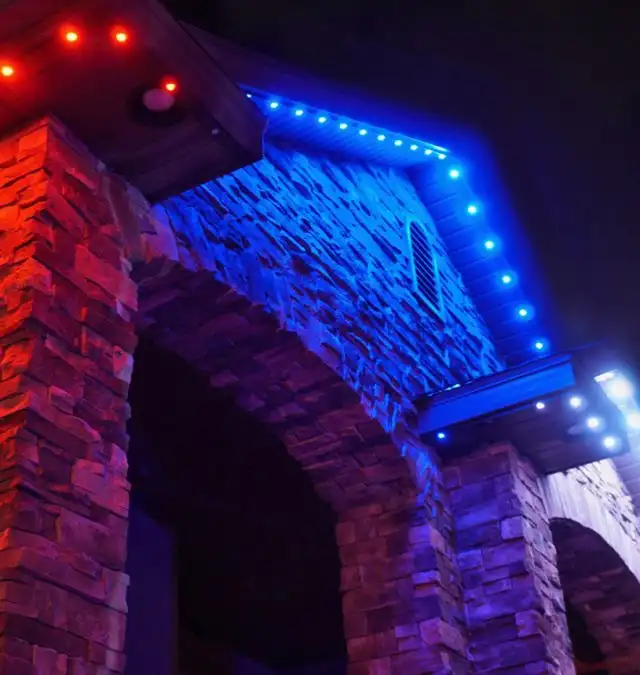
Permanent Lighting
Will Permanent Lighting Damage My Roof, Soffit or Fascia? A Cincinnati Homeowner's Guide
New Age Lights • August 2026 • Cincinnati, OH • 8 min read
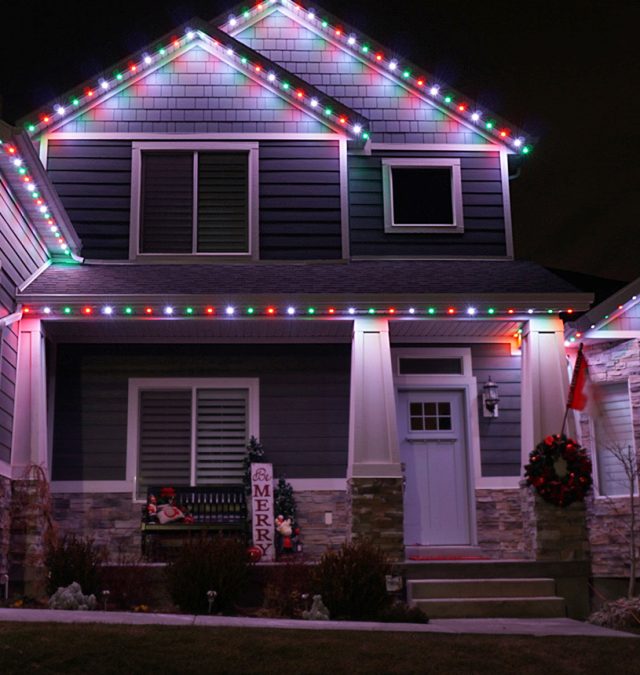
Where the track actually mounts
Permanent roofline lighting is not attached to the roof. It is attached to the trim under the roof's edge. On most houses that means one of three surfaces.
- The fascia. The vertical board that runs along the eave, behind the gutter. On newer housing in Mason, West Chester, Fairfield, Florence and Independence this is a straight, continuous board, often wrapped in aluminum, and it is the cleanest place a track can go. The channel sits just below the gutter line and reads as a trim piece.
- The soffit. The horizontal underside of the eave. Where the fascia is shallow or the gutter sits low, the track is fastened to the soffit at the outer edge so the lights throw down and out across the wall. Houses read from below, like many on Mount Lookout or the west side of Fort Thomas, often look best lit from the soffit.
- The drip edge line. On some roof types the track is set immediately under the drip edge flashing. Even here the fasteners go into the fascia or sub-fascia behind it, not into the roofing.
In every case the fasteners are screws into wood or the sub-fascia behind an aluminum wrap. No nails, no staples, nothing through roofing material of any kind.
What the wiring path looks like
Both systems we install, JellyFish Lighting and Bosso Smart Lighting, are low voltage. The lights are wired inside the channel, so there is no exposed cable along the roofline. At one point on the run, usually the corner nearest the garage, a wire drops to the controller. That drop is routed along trim or downspout lines and enters the building at a sealed penetration through the fascia, soffit or exterior wall, never through the roof deck.
The controller sits indoors or in a protected spot. Bosso specifies a UL-rated waterproof controller, typically mounted in the garage, and both controllers need a power outlet and a solid Wi-Fi signal. On a large Mason lot with a detached garage, the Wi-Fi reach is a detail we check at the consult. On a new build, all of this can be hidden inside the walls before drywall, which is why our home builder program exists.
Do permanent lights damage the roof or soffit?
No, when installed to this standard. The failure mode people worry about, water getting behind the roofing at a fastener, cannot happen when there are no fasteners in the roofing. The soffit and fascia are designed to be fastened into; that is how gutters, gutter guards, soffit vents and exterior lighting are already attached to your house. A lighting track adds a row of screws into the same board, sealed at the one point where a wire passes through.
What can cause damage is careless work: a fastener through a shingle, an unsealed wire entry, or a track screwed to a rotten fascia board that should have been flagged. Those are installer problems, which is why the consult starts with a close look at the edge.
Material by material: what happens on Cincinnati housing
Cincinnati has more variety at the roof edge than any other market we work in. Here is how the track behaves on each.
| Roof or trim | Where it is common | How the track mounts | What to know |
|---|---|---|---|
| Asphalt shingle, aluminum-wrapped fascia | Mason, West Chester, Fairfield, Florence, Independence | Screws through the wrap into the sub-fascia | The easiest case. Track color-matched to the wrap and it disappears in daylight. |
| Slate roof, painted wood fascia and deep cornice | Hyde Park, Clifton, Norwood, Wyoming, Fort Thomas | Fascia or soffit only; slate is never touched | A cracked slate is a roofing bill, not a lighting one. Cornice depth decides whether the track can sit out of sight. |
| Clay or concrete tile | Fort Thomas, parts of Hyde Park and Mount Lookout | Fascia or soffit only | Same rule as slate. Tile eaves are often deep, which helps. |
| Standing-seam or metal roof | Newer builds, additions, some commercial | Fascia or sub-fascia under the drip edge | Metal expands and contracts more than shingle; the track is independent of it. |
| Brick with masonry cornice, no wood trim | Over-the-Rhine, Covington and Newport river blocks, some Clifton | Often no suitable seat for a track | We do not drill decorative masonry for a lighting channel. A designed seasonal display on the fascia line is usually the right product here. |
| Vinyl soffit, aluminum fascia | 1980s to 2000s suburban housing on both sides of the river | Screws into the wood behind the vinyl or wrap | Vinyl alone will not hold a fastener; the wood behind it does. We confirm it is sound. |
| Built-in box gutter | Older Norwood, Wyoming, Covington housing | Fascia below the gutter, if there is one | Box gutters change the profile of the edge; the site visit decides whether a track seats cleanly. |
On the older half of that table, the honest outcome is sometimes that a track is not the right product for the house. We would rather say that in your driveway than sell you a fixture that shows in daylight on a Covington Italianate front.
Snow, ice and freeze-thaw
This is the local test. December averages a high near 42°F and a low near 27°F, snow accumulates on the roofline rather than passing through, and a freeze can hold for days. Three things follow from that for a permanent track.
First, fixing spacing. A track fastened at the intervals that suit an Alabama winter is not the same installation as one set for snow load and sustained freeze. We space fasteners for the weather this side of the Ohio River actually delivers, and that is the main way a Cincinnati install differs from the same house further south.
Second, water. The track sits under the eave, behind the drip line. Meltwater runs off the roof into the gutter in front of it, and icicles form on the gutter lip, not on the channel. Ice dams, where they happen, are a roof ventilation and insulation problem at the shingle line above, and a lighting track under the soffit neither causes nor worsens them.
Third, movement. Aluminum expands and contracts with temperature, and the channel and its joints are designed to move with it. Every penetration is sealed against sustained cold, because a January fault here is not a pleasant afternoon to fix. Both manufacturers rate their systems around 50,000 hours; JellyFish points to installs from 2016 still running, in climates colder than this one.
Gutters and gutter guards
The track is independent of the gutter. It sits below or behind the gutter line and does not block flow, so gutter guards, downspouts and seasonal cleaning carry on as before. If you replace your gutters later, the track is normally undisturbed; if a new gutter profile changes the edge, the track can be re-seated.
Historic districts and HOAs
Because nothing goes through the roofing and the track unscrews from the trim, a permanent lighting install is reversible. That matters in two places. In historic districts, including Over-the-Rhine, the riverfront and MainStrasse blocks in Covington and the older streets of Newport, exterior changes may need review before anything visible is fixed to the building, and a reversible, color-matched fixture is an easier conversation than a permanent alteration. Check whether your district requires a certificate of appropriateness or a review-board sign-off, and bring the rules to the consult.
In HOA neighborhoods in Mason, West Chester, Florence and Independence the concern is usually daytime appearance rather than the building fabric, and the color-matched channel is the answer. Our post on permanent outdoor lighting and HOAs in Cincinnati covers what to submit.
What the warranty covers
JellyFish carries a five-year parts warranty with year one bumper-to-bumper, covering parts, labor and service. Bosso carries five years on parts and one year on labor. New Age Lights adds a workmanship warranty on the installation itself. Because we install and service every system we sell, a dropped run or a misbehaving zone is a call to our Deer Park office, not to a manufacturer's support line, and the person who fitted the track is the person who comes back.
If it ever has to come off
Rarely asked, worth answering. The track unscrews from the fascia or soffit, the wire drop is pulled and the entry point sealed, and the screw holes in the trim are filled and painted. Because no roofing material was ever penetrated, there is nothing on the roof to repair. More on how the two systems compare in JellyFish vs Bosso for Cincinnati homes, and more local answers on our FAQ page.
Frequently asked questions
Do permanent lights damage the roof or soffit?
Not when installed properly. The track is screwed to the fascia board or the underside of the soffit, the same structure your gutters already hang from. Nothing is nailed, stapled or screwed through shingles, slate, tile or metal roofing. The only penetration is a sealed, low-voltage wire drop to the controller, usually at the garage.
Can you install permanent lighting on a slate roof in Cincinnati?
Yes, provided the house has a fascia or soffit line to fasten to. On the slate-roofed housing in Hyde Park, Clifton, Norwood, Wyoming and Fort Thomas the track goes on the trim, never on the slate. Where a masonry cornice leaves no wood to fasten to, we say so at the consult and usually recommend a designed seasonal display instead.
Will snow and ice pull the track off?
A track fastened to the fascia at spacings set for load will carry an Ohio Valley winter, which is the same load your gutters carry every year. The track sits under the eave, behind the drip line, so meltwater and icicles form on the gutter in front of it rather than on it. Fixing spacing here is tighter than it would be in a southern market.
What happens if I replace my gutters or repaint later?
The track is independent of the gutter, so a gutter replacement does not disturb it in most cases. Repainting the fascia means masking or briefly unclipping the track; the channel itself is color-matched to your trim and can be matched again to a new color.
Can permanent lighting be removed?
Yes. The track unscrews from the fascia, the wire drop is pulled and the entry point sealed, and the screw holes in the trim are filled and painted. No roofing material was ever touched, so there is nothing on the roof to repair.
What does the warranty cover?
Both systems New Age Lights installs carry a five-year parts warranty, with the first year also covering labor. New Age Lights adds its own workmanship warranty on the installation and services every system we sell, so if a section drops out you call us, not a manufacturer's support line.
Have us look at your edge before you decide
The consult is free and it starts with the fascia, the soffit and the gutter, because that is what decides whether a track fits your house. If it does not, we will tell you.
Get a free quote or call (513) 713-0490.